
Ich bin ein New Yorker
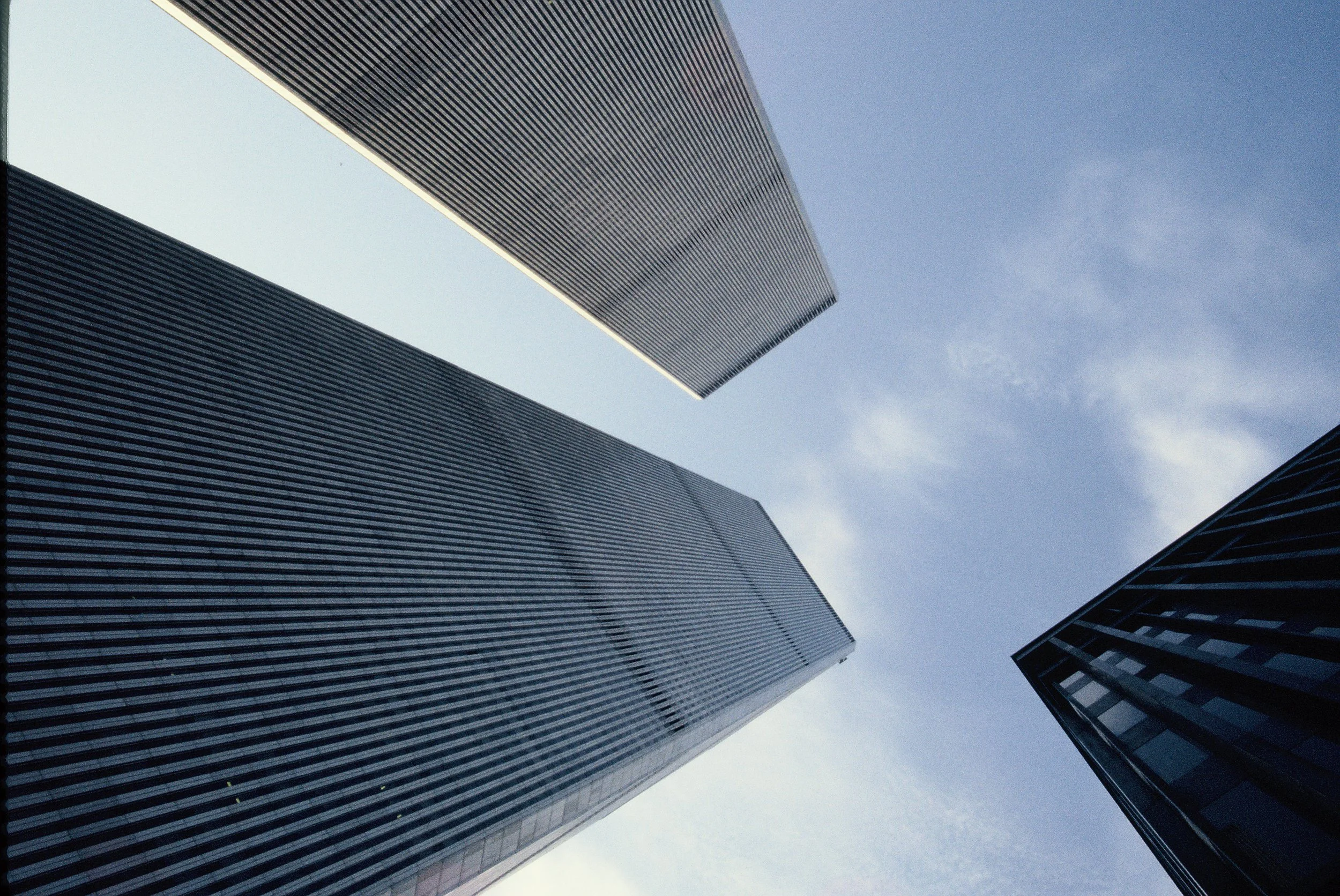
On this 25th anniversary of 9/11, I am reposting the text of my original photo essay written weeks after the event. We were Upper West Siders at the time (the part of Manhattan above 59th St.), and put together this post (originally liberally laced with a couple dozen photos) a few months later once we collected our thoughts. Reading it a quarter century later still brings back raw feelings of immediacy, not to mention lasting impressions of how 9/11 brought out the inner generosity, perseverance, and bravery of New Yorkers.
The title is based on a quote from President John F. Kennedy's address in front of the Berlin Wall, which translated means "I am a Berliner." On September 11, we were all New Yorkers.
We are sharing this with in you in the hopes that we will never forget.
Original post:
The tragedy of 9-11 brought New York City and the country full circle. For all too long, New Yorkers felt alienated from the rest of the country and vice versa. Remember that 1976 Saul Steinberg New Yorker magazine cover showing a Manhattanite's view of the world? The U.S. was a small patch of turf between Canada, Mexico, and Pacific. Of course, what we dished out, we got back. Recall that famous Daily News headline during the city's financial crisis: "FORD TO CITY: DROP DEAD."
In the end, the city didn't drop dead and the Ford administration came to its senses. Unfortunately, being the 70s, we still had to suffer a few more years of disco, but we eventually stopped wearing polyester. Today, Studio 54 is the place to see the revival of Cabaret.
More importantly, New York-and the rest of the civilized world-came together after 9-11. Maybe it's just a temporary blip of sympathy, but the reality is that the country came through with repeated random acts of kindness, ranging from the billion and a half dollars for Trade Center victim families to the donations of repairs, spare parts, and even brand new fire trucks to the Fire Department (FDNY) after the attack.
We even cheered when George W. came to Ground Zero, even though virtually nobody in the crowd likely voted for him. And we cheered for our mayor, who in normal times was not always the most likeable of characters. But Rudy delivered the right combination of leadership under fire with humility, displaying to the world that New Yorkers are not just street smart, but that beneath the rough exterior, we have heart.
New York is a city that constantly tears down and builds up. It's the only major east coast city, dating from colonial times, which failed to preserve its colonial section. Yesterday's New Amsterdam became today's Wall Street. And unfortunately, we lost Penn Station. From those standpoints, New Yorkers have never been terribly sentimental.
Not surprisingly, before 9-11, we had a love/hate relationship with the World Trade Center. It destroyed the old "Radio Row," the city's original center of consumer electronics. The same place that helped make Avery Fisher, a pioneer of high-fidelity audio systems, rich enough to endow Lincoln Center with the funds to mitigate Philharmonic Hall's notoriously poor acoustics (the hall was subsequently renamed for him). OK, maybe I'm getting a bit sentimental here. I bought my first stereo-a Fisher-from one of those stores on Radio Row.
The trade center destroyed the symmetry of the downtown skyline. To get an idea of the impact of the Trade Center, look closely at the photograph. All the buildings to the left of the Twin Towers were erected on landfill that came from the excavation for the Trade Center. When the Trade Center opened in 1973, it made the Lower Manhattan skyline appear like it was tipping into the Hudson. But once the World Financial Center (those buildings to the left of the towers) opened, along with the new Battery Park City neighborhood of 10,000 - 15,000 people-the skyline assumed a new balance.
Over the years, we just got used to the Trade Center. Depending on your viewpoint, its minimalist design was either bland or beautiful. Like a blast of testosterone, the Twin Towers splashed New York's grandeur straight in your face. We ended up taking for granted the fact that, looking down 6th Avenue in the Village, 7th Avenue in Chelsea, or West Broadway in Soho, the Twin Towers gave the neighborhoods tidy visual endpoints. To paraphrase Joni Mitchell, "You never know what you've got till it's gone." In this case, during our years of photographing the streets of New York, we never got around to taking this one. The twin towers also provided the props for countless ads symbolizing the Big Apple, the Big Time, the Next Big Thing, or in Microsoft's case, Big Computing. (Microsoft's ad was still running just before the attacks happened.)
We traveled down to the war zone as soon as it was opened to the public. Climbing out of the Fulton Street subway stop, the first shock was, "What's wrong with this picture?" Before 9-11, that should have been the North Tower staring down at us. Now instead, it was the American Express Tower in the World Financial Center.
The next immediate shock was seeing the outdoor banner ads for eSpeed, Cantor Fitzgerald's electronic marketplace for trading government bonds. Overhyped expectations surrounding B2B online commerce ranked among the worst excesses of the dot com era. Ironically, online commerce may have helped save Cantor Fitzgerald's business after it lost about 60 - 70% of its workforce in the attacks.
Turning south onto Broadway, a block east of the site (as close as we could get), we were struck by the martial law atmosphere. It looked like downtown had just been through a major armed riot.
On Broadway, we peered down dark alleys to catch glimpses of the wreckage. Looking west on Cortland Street from Broadway, we began to get an idea of the scale, with the debris stacking 6 - 7 stories high in some places.
And from One Liberty Plaza-the dark building directly east of the complex, which eventually reopened after many false warnings of its demise-we finally saw the big picture. The vast devastation spread over 16 acres, and the South Tower skeleton that appeared in all the news feeds. It's our hope that, when they finally build the memorial to the victims, that some piece of this skeleton will become part of it. To us, the skeletal fragment symbolizes both the savagery of the attack and the resolve to recover.
The blazes burned on for more than 3 months, like a fire in an underground coal seam. Barely a couple weeks after the attack, the air remained dark and dusty. For the folks who lived downwind (primarily in Brooklyn Heights, Tribeca, and Battery Park City), we would rather not contemplate what they were breathing in that fall.
We've mentioned the American Express building of the World Financial Center several times. Standing on the other side of the West Side Highway, due west of the Trade Center, the building was a true survivor. Unlike the Twin Towers, whose structural supports were in their skin, the World Financial Center buildings used more conventional designs that concentrated the structural core in the center of the building. A close-up here reveals the damage sustained; in this case, a piece of the Twin Towers skeleton pierced several corner offices. (Maybe working in cubicles isn't so bad after all.) When we visited the sited in December, the corner of the building had been neatly cut away for repairs.
The good news: American Express plans to reoccupy most of the tower by midyear. And Merrill Lynch, which occupies a neighboring tower (not shown), is doing likewise. Don't count the city out!
We saw many shop owners and employees cleaning out their stores when we passed by. They are among the unsung heroes who are slowly bringing Lower Manhattan back to life. Life won't be easy for retailers, now that the weekday population has dropped by 100,000.
Among the most publicized of the cleanouts was a lower Broadway Levis store. The owners have since preserved the sooty 501 jeans in a plexiglass case, not as a new fashion statement, but as the city's first permanent 9-11 memorial.
And of course, what New York scene is complete without graffiti? After the 9-11 attacks, the graffiti etched in the dust of a retail display window off lower Broadway took on unusually patriotic tones.
Autumn in New York
As if somebody was playing a cruel joke, September 11 was New York weather at its very best. A fresh Canadian high, deep blue cloudless skies, temperatures in the 70s, and practically no humidity. In fact, the weather held almost the entire week. A few days after the attacks, we checked out the New Jersey and Brooklyn waterfronts (as close as civilians were allowed to get at that point) to gape at the smoke and the void.
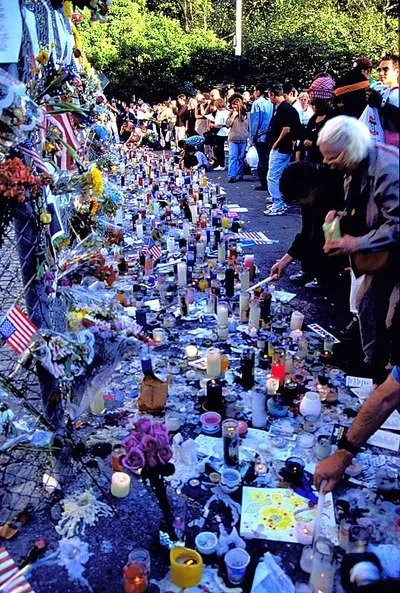
Back to September 11. It should have been a great day to be outdoors. Ironically, most Manhattanites were, because the subways and trains were largely shut down. At our vantage point on the upper west side, the sidewalks were jammed between 11 and 3, with virtually everyone heading uptown. By 3:00, a deathly quiet descended. Streets were empty, people were dazed. It was like the aftermath of a political assassination.
And then we gathered in countless vigils all over town. That day we stood on a west side pier with thousands of others in silence, and saw the first convoy of rescue trucks head down the West Side Highway. We counted over 50 vehicles in that first convoy, which stretched at over a couple miles long.
The next day, when subway lines to the other boros reopened, we made our way to console some friends and family in Brooklyn Heights, due east and downwind of Ground Zero. And that's where we saw the first of hundreds of spontaneous memorials that sprang up in just about every public space in town. The next day, we made our way to Union Square and Washington Square, joining thousands of our neighbors to pay our respects.
And then we gathered in countless vigils all over town. That day we stood on a west side pier with thousands of others in silence, and saw the first convoy of rescue trucks head down the West Side Highway. We counted over 50 vehicles in that first convoy, which stretched at over a couple miles long.
The next day, when subway lines to the other boros reopened, we made our way to console some friends and family in Brooklyn Heights, due east and downwind of Ground Zero. And that's where we saw the first of hundreds of spontaneous memorials that sprang up in just about every public space in town. The next day, we made our way to Union Square and Washington Square, joining thousands of our neighbors to pay our respects.
A Small Town
Within hours of the attacks, family and friends of those missing began taping up posters of the missing. Even with just a photo and sparse information, the cumulative effect was that the victims who perished became more than just numbers or strangers. Maybe we never had the chance to meet personally, but they became our friends.
We also credit the New York Times for preserving their memories, through its ongoing series of profiles of the victims. The Times plans to publish the profiles in a book later this year.
That sense of community became more apparent when, a couple days after the attacks, we gathered to deliver spare clothes and canned food to relief workers. Around 3 in the afternoon, one of our neighbors in our apartment building put out a notice in the lobby asking for donations of canned goods and spare clothing for the relief workers. He planned to pull up his Camry around 8 and cart a few boxes over the local firehouse, about 4 - 5 blocks away. Three hours and nearly 40 boxes later, about 20 of us from the building (most of whom had never met before) finished organizing and packing the donations. We waved down a police car to stop traffic so our 8-car motorcade could make the trek to 65th and Amsterdam, where we unloaded past yet another vigil (the firehouse lost about a half dozen of its own). Seeing our friends and neighbors from the neighborhood standing by the local firehouse seemed a real Norman Rockwell image.
But as we bonded in community, we were constantly reminded of the horror that brought us all together. On our way back from the drop-offs, we passed yet another poster in our lobby. This one as was from a 9-year old girl in the building, which asked if anybody had seen her mommy.
Life Goes On
As of early 2002, the death toll from the attacks was revised to under 2900 people, less than half the early estimates-but of course, 2900 too many. Still, considering that in a typical business day, the population of the Twin Towers was estimated between 30,000 - 50,000, it was quite miraculous that at least 20,000 - 25,000 people escaped (the remainder had probably not yet made it up to their offices, given the early hour).
That's quite a tribute to New York's public safety workers, who sacrificed their lives so that so many more could live to tell the story, not to mention the city's excellent disaster response system. Just about the only major flaw was the location of the city's original emergency command bunker-at 7 World Trade Center (a building where they stored thousands of gallons of diesel fuel). When American Airlines 587 crashed in Rockaway barely a month later, the fire department quickly confined the damage to four homes. (There was almost an eerie sense of déjà vu when we saw Rudy addressing reporters in front of yet another conflagration.)
Today, the cleanup, which was expected to take over a year and cost billions of dollars, is likely to wind up by May or June, and come in well under budget. And the numbers 1 and 9 subway lines-whose Cortlandt St. station was destroyed in the attack-are set to reopen by year-end, not the 3 -4 years previously forecast. When it counts, New York gets the job done.
The struggle for survival has always been a central theme of New York history. When the city was destroyed during the Revolutionary War, it came back a decade later as the nation's first capital. We survived as part of the diverse mosaic that is America. The key is that New York has always been port of entry for The American Dream, a city of immigrants.
In generations past, it was where Jews, Irish, and Italians worked their way up through the garment industry, the construction trades, civil service, neighborhood stores-and even the mob-to give their children the opportunity of a better life.
That cycle continues today. The vitality of New York comes from the Koreans who brought fresh produce back to the inner city after national supermarket chains fled to the suburbs. The Greeks who opened the diners that made good, square meals affordable. The Pakistanis who man the subway newspaper stands that, not only gave subway riders diversions to make their trips less unbearable, but provide continual human presence to make subway station platforms safe. The Haitians who drive the taxis that make it possible for you to get home or to your appointment quickly. The Caribbeans who revived Nostrand Avenue. The Chinese who helped a whole generation of Jewish grandmothers avoid the drudgery of making dinner. And any of the new ethnic groups that constantly make New York a different city every year.
And New York will thrive, not just survive. Years ago, the financial industry collected in Lower Manhattan because the securities business relied on the flow of stock certificates that had to be messengered over to different brokerage houses, each time a trade was made. Eventually, technology advances enabled the financial field-like every other sector-to be tied together, not by "runners" but by electronic networks.
The continued operation of the New York Stock Exchange, the return of major players like Merrill or Amex, does not deny the reality that the financial industry will continue to decentralize operations, and that Lower Manhattan must once again reinvent itself. Given New York's track record, we have no doubt that it will.
The original post with all the 20+ photos is available on the Web Archive at this link: https://web.archive.org/web/20020804022814/http://www.onstrategies.com/files/911.html#top